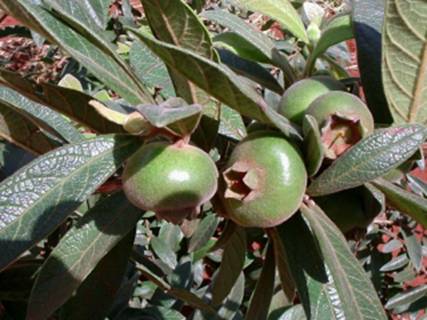
CAMPOMANESIA SESSILIFOLIA VAR. BULLATA
POPULAR NAMES: Green Guabiroba, Guabiroba verde, Cambiraba , Ibabiraba Ibabiraba
MYRTACEAE
INDIGENOUS NAME: Ibabiraba comes from the Tupi Guarani and means "Bright fruit" or Cambiraba de Caa - leaf or grass, and Raua - Brilliant or "herb of bright leaf" characteristic and striking as the fruits and leaves glow at the lowest signal light.
Origin: This plant occurs in the fields and hills everywhere in Brazil, especially in Mato Grosso do Sul and Minas Gerais, Brazil.
Characteristics:
It is a shrub of medium
size, reaching
Planted in the site of Frutas Raras: It was planted in September of 2003, began to bear fruit in 2006.
Tips for planting: Tree of moderate growth and is resistant to frost to 0°C (32°F), thrives in every altitude. The soil may be deep, moist, acid, with sandy formation and with good natural fertility. The tree begins to fruit in the age of 3 years and needs special care in the juvenile age because the plant is very delicate and sensitive to drought in the first year. The best season for planting is the month November.
Propagation:
The seeds are tiny,
measuring a maximum
Planting:
Should be planted in full
sun in a space of 5 x 5
m (17 x 17 feet).
In the first year they
have to
receive constant irrigation.
The holes must contain
300g of lime and 500 g of ash, 30% sand and
Cultivating: Make only form pruning of the crown and remove branches that were grown from the base of the trunk. Fertilize with organic compost, may be (4 liters) well mixed organic compost + 30 g of NPK 10-10-10 doubling that amount every year until the 4th year.
Uses: The fruits are bright green and even when ripe and very sweet, ideal for in-natura consuming, because seeds are not as sour as in other species of Guabirobas. The fruit has great potential for the consumer market to be challenged and great use to make jellies and delicious ice cream.
Flowering in the site of Frutas Raras: August to February.
Fruting in the site of Frutas Raras: November, January, March and April.
Back to the seedlist (English) or back to Myrtaceae (Portuguese)