EUGENIA ARRABIDAE
FAMILY OF MYRTACEAE
|
|
|
|
Flowers |
Mature fruits |
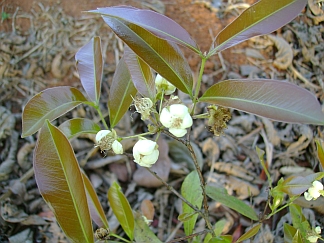
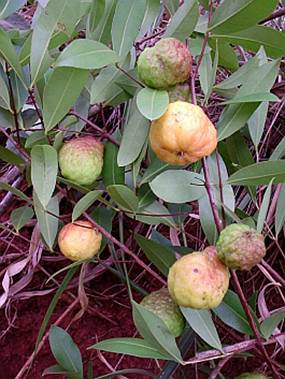
NOMENCLATURE AND IMPORTANCE: UVAIA-PEBA comes from the Tupi-guarani and means "sour fruit" and PEBA “creeping down”. Also called as Uvaia do cerrado or Rounded Field Pear.
Origin: Endemic Brazilian species and very rare, only on the sand of Rio de Janeiro occurring, but also occurs in the area of the savannah of São Paulo State. More information in Portuguese at the link:
Note: Species originally named as Eugenia campestris. "O site as flora do Brasil", describing it as the only in the state of Rio de Janeiro occurring, the second the "Dicionário de Planta úteis do BRASIL - PIO CORREA" the species that is also in the state of São Paulo and in fact also the species here in the communities Campina do Monte Alegre and Angatuba Paranapanema.
Characteristics: It is a 1 to 2 m tall shrub with underground Xylopodium (water-storing type tuber) with many branches from the base, the old trunk is gray and the new branches are bare (hairless) of green to light brown changing color, the leaves are simple and have a consistent of papery state (like cardboard, oblong and lanceolate. The blade measures from 3 to 6.4 in length and 0.8 to 1.4 cm in width, (long tip) with the acute or tapered base and sharpened apex having a dorsal fin projecting strong yellow color. The flowers are hermaphroditic, they are 2-8 on the tips (V-shaped inflorescence bunch type) that appear in the axils of leaves gathered at the annual shoots. The flowers are 1.5 cm in size and provided with numerous white stamens (male pipe). The juicy fruits are berries of up to 3 to 5 cm in diameter with a fleshy, watery and sour pulp, rounded to 3 with 1 seed from 6 mm to 1.2 cm in diameter.
Culture Tips: It is a slow growing plant, more adapted to different climatic conditions, occurs on roadsides in sandy soils, is always the first to be cast out again when their habitat is burned. It can be grown at altitudes of 200 to 1000 m in areas with sandy or loamy texture (yellow or red soil) with the optimal stormwater runoff. They tolerate frosts down to -3 ° C and up to 5 months of drought with no rain. They can be grown in pots, and the fruit begins at age of 4 to 6 years.
Propagation: The seeds are recalcitrant and lose their ability to germinate quickly, they should be sown up to 30 days after harvest. They should be sown directly into individual bags containing 50% red soil and 50% organic material. Germination occurs after 40 to 100 days, the seedlings reach 15 cm after 10 to 12 months. The seedlings grow best in full sun with daily watering.
Planting: Can be planted in full sun in space at a distance of 2 x 2 meters, the hole should measure the depth, width and length of 50 cm each, should be filled 30 cm of well-mixed, fertile soil in 18 liter gritty sand, 4 kg of well mixed manure, 300 g of lime and 1 kg of wood ash. Leave in for 2 months and do the planting from October to December. After planting pour with 10 liters of water and then pour once a month when it is not raining. Use for planting in pots (50 cm high and 40 cm wide) red soil and the same mixture as above, it must be ensured that a 4 cm drainage layer is placed on the bottom of the pot to ensure a rapid withdrawal.
Culture: It grows slowly and needs no special care, just the regular weeding should be done so that the plant is not stifled. There is no need to prune. Fertilize with compost, it can be 2 kg of poultry manure + 20 g of NPK 10-10-10, within the area spread 5 cm deep and at a distance of 10 cm from the trunk.
Use: Fruiting from October to December. The fruits can be used in kind or for the production of refreshing juices. The pulp ferments easily, can be used for the production of good vinegar and good wine. The flowers provide nectar and pollen for native bees. Very rare species, which must be saved.
Back to the seedlist (English) or back to Myrtaceae (Portuguese)